
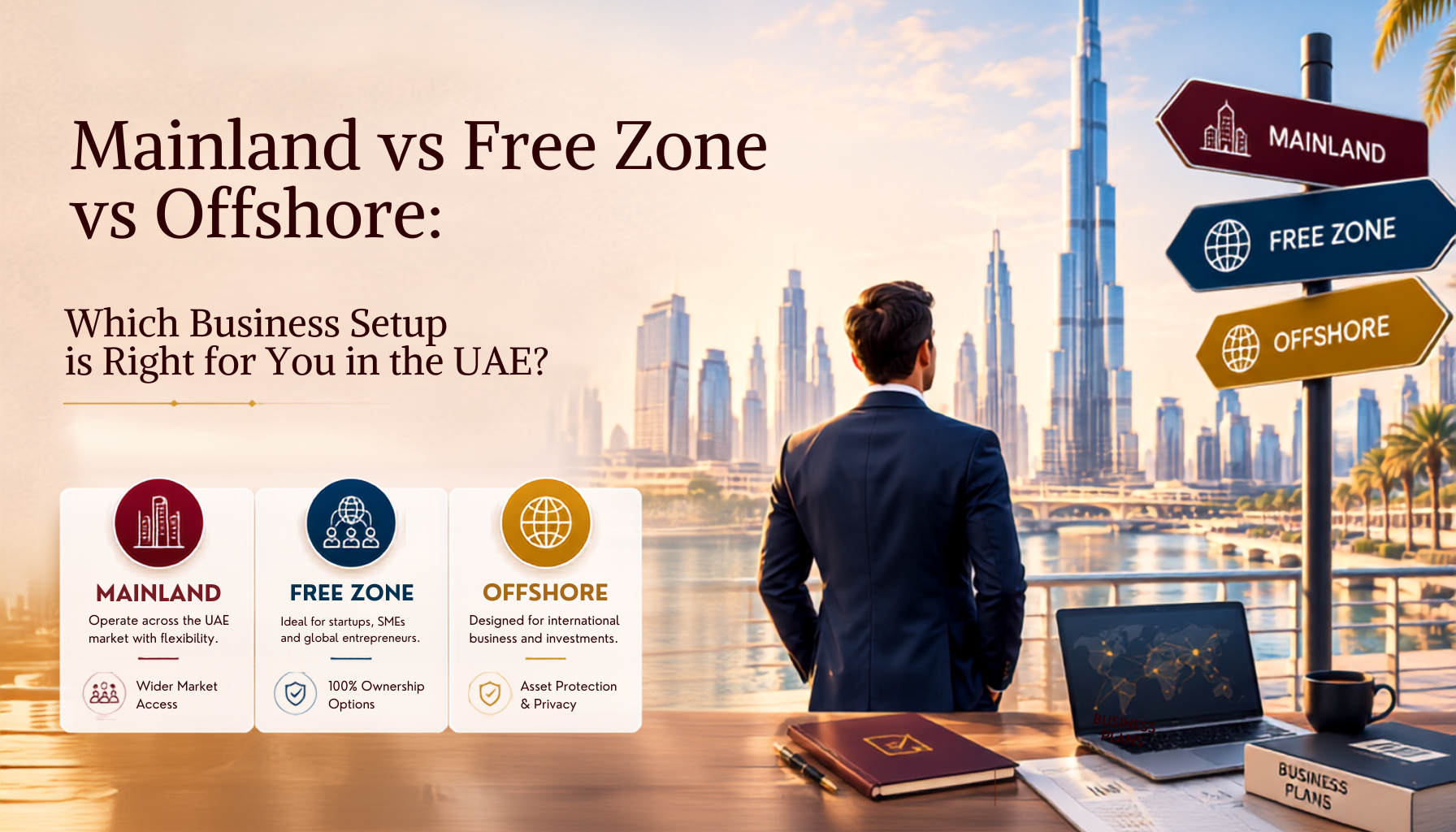
Which Business Setup is Right for You in the UAE?
Starting a business in the United Arab Emirates is one of the most exciting decisions an entrepreneur can make. The UAE continues to attract startups, established companies, investors, freelancers, and international businesses because of its strategic location, modern infrastructure, business-friendly regulations, and access to global markets.
However, one question almost every entrepreneur asks before registering a company is:
Should I choose Mainland, Free Zone, or Offshore?
While all three structures offer legitimate ways to establish a business in the UAE, they are designed for different business objectives. Choosing the wrong structure can lead to unnecessary costs, operational limitations, or future restructuring.
This guide explains the key differences, advantages, and ideal use cases for each option so you can make an informed decision.
Why Choosing the Right Business Structure Matters
Your company structure affects much more than your business license.
It influences:
-
Where you can legally operate
-
Ownership flexibility
-
Licensing requirements
-
Visa eligibility
-
Tax considerations
-
Business expansion
-
Banking requirements
-
Long-term operational costs
Selecting the right structure from the beginning saves both time and resources as your business grows.
Related Reading: Complete Guide to Business Setup in the UAE: Everything You Need to Know Before You Start
https://docuvion.ae/blog/complete-guide-to-business-setup-in-the-uae
Although they are all registered within the UAE, Mainland, Free Zone, and Offshore companies serve different purposes.
1. Mainland CompanyA Mainland company is licensed by the relevant Department of Economy and Tourism (or equivalent licensing authority within the emirate where the business is established).
Mainland companies are generally suitable for businesses planning to operate directly within the UAE market.
Best suited for
-
Retail businesses
-
Restaurants
-
Consultants
-
Construction companies
-
Trading businesses
-
Professional service firms
-
Healthcare providers
-
Educational institutions
Advantages
✔ Operate across the UAE
✔ Work with government entities (subject to eligibility)
✔ Flexible office location
✔ Broad range of licensed activities
✔ Easier local market expansion
Consider before choosing
Certain regulated activities may require additional approvals depending on the business sector.
2. Free Zone CompanyFree Zones are specially designated business areas created to encourage investment and international trade.
Each Free Zone is managed by its own authority and often specialises in particular industries such as technology, logistics, media, healthcare, finance, or manufacturing.
Best suited for
-
International entrepreneurs
-
Startups
-
E-commerce businesses
-
IT companies
-
Consultants
-
Digital agencies
-
Export businesses
Advantages
✔ 100% foreign ownership (where applicable)
✔ Streamlined registration process
✔ Industry-focused ecosystems
✔ Modern infrastructure
✔ Attractive business support services
Consider before choosing
Operating directly in the wider UAE market may require additional arrangements depending on your business activity.
3. Offshore CompanyAn Offshore company is generally established for international business activities rather than conducting commercial operations within the UAE domestic market.
These companies are commonly used for holding investments, protecting assets, managing international trade, or owning intellectual property.
Best suited for
-
International investors
-
Holding companies
-
Asset management
-
Global trading
-
International investments
Advantages
✔ International business flexibility
✔ Asset protection
✔ Corporate privacy
✔ Suitable for global ownership structures
Consider before choosing
Offshore companies are not intended for conducting regular commercial business within the UAE local market.
Quick Comparison
|
Feature |
Mainland |
Free Zone |
Offshore |
|
Operate in UAE market |
✔ |
Limited depending on activity |
✘ |
|
International business |
✔ |
✔ |
✔ |
|
Foreign ownership |
Available for many activities |
✔ |
✔ |
|
Office requirement |
Usually required |
Depends on zone |
Usually not applicable |
|
UAE residence visas |
✔ |
✔ |
Generally not |
|
Asset protection |
Moderate |
Moderate |
Strong |
|
Suitable for startups |
✔ |
✔ |
Limited |
There is no universal answer.
The best choice depends entirely on your business objectives.
Choose Mainland if:
-
You want to serve customers across the UAE.
-
You plan to expand locally.
-
You need flexibility in business activities.
-
You expect to work with local clients.
Choose Free Zone if:
-
You are launching a startup.
-
Your clients are international.
-
You operate online.
-
You want a streamlined setup process.
Choose Offshore if:
-
You manage international assets.
-
You operate outside the UAE market.
-
You need a holding company.
-
You require international corporate structuring.
Many businesses choose a structure based only on setup costs.
In reality, long-term suitability matters far more.
Some common mistakes include:
-
Choosing a licence before defining business activities
-
Ignoring future expansion plans
-
Selecting the wrong jurisdiction
-
Underestimating banking requirements
-
Overlooking visa needs
Professional guidance at the planning stage can help avoid costly changes later.
Frequently Asked QuestionsWhich business setup is the least expensive?
Costs vary depending on the jurisdiction, licence type, office requirements, and business activity. It's important to compare the overall value rather than only the initial registration fee.
Can I convert from Free Zone to Mainland later?
In many cases, businesses can restructure or establish a new entity as their requirements evolve. The appropriate approach depends on the business activity and regulatory framework.
Which option is best for international entrepreneurs?
Many international entrepreneurs choose Free Zone structures because of their flexibility and business-friendly environment. However, the right choice depends on where the business intends to operate and grow.
Can I own my company entirely as a foreign investor?
Ownership regulations vary depending on the business activity and jurisdiction. Many sectors allow full foreign ownership, while certain regulated activities may have specific requirements.
Choosing between a Mainland, Free Zone, or Offshore company is not simply an administrative decision it shapes how your business operates, grows, and serves its customers.
Taking the time to understand each option helps create a stronger foundation for future success. Rather than focusing only on registration, entrepreneurs benefit from considering their long-term goals, target markets, operational needs, and expansion plans before selecting a business structure.
Whether you're launching a startup, expanding into the UAE, or building an international venture, making an informed choice today can simplify tomorrow's opportunities.